For tire and wheel shops
Tire shop software for the front desk, not the bay
Tire shop software for the front desk. We do not quote tires, we answer the call about them and take the booking.
14-day free trial, every feature unlocked, no credit card required
SV Owner on a phone: the shop's alerts showing a missed call from Priya Sandhu sixteen minutes ago with the note that she was texted back automatically, the inbox reading one thread waiting on you with her conversation marked Needs reply, the call log carrying that call with her voicemail on it, the transcript of what she said (a price on the five-year ceramic for a Macan, and whether she can drop it on a Saturday), and the text that went back a minute after the call, which nobody typed.

For a tire and wheel shop, Service VIN is the front desk and marketing layer that runs alongside the shop system you already have: the phone answered, the booking request taken, the review asked.
The short answer
Can Service VIN run a tire shop, or does it sit beside my system?
It sits beside it. Service VIN does not quote tires, because a tire quote needs fitment, a size and load index and live distributor stock, and it has none of those. What it takes is the front desk and the marketing: the missed call, the booking request, the review and the ads.
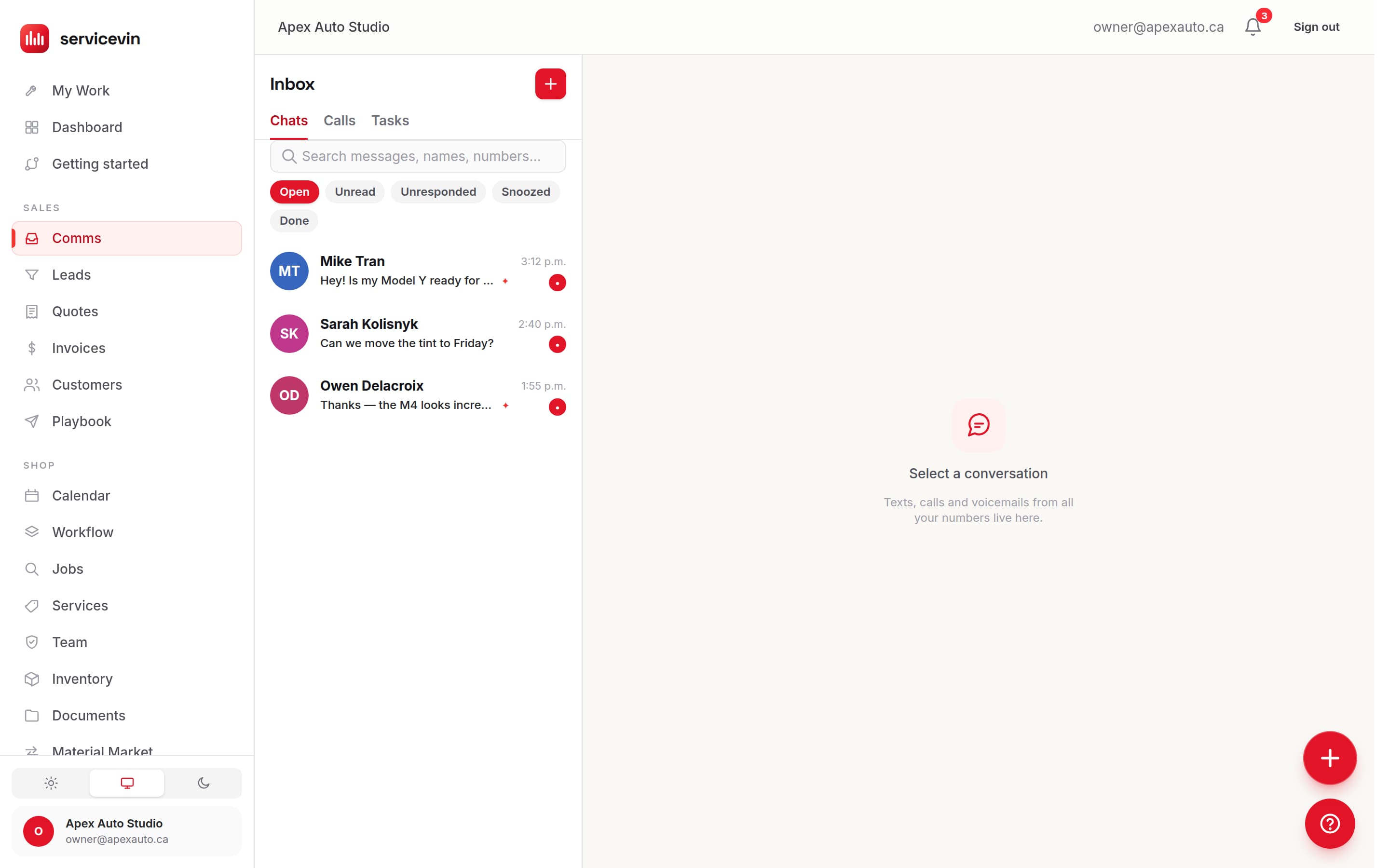
- The shopper who price-checked online and then rang you reaches somebody, or gets a text back from your own number within seconds.
- A booking request arrives with the vehicle and what it needs, on the customer's own thread, for whoever is at the counter to slot into your schedule.
- Calls are recorded, transcribed and summarised on the record, so the second call about the same set of winters is not a fresh conversation.
- The review ask goes out after the car leaves, and a seasonal reminder goes to the customers you already have from the shop's own line.
- Nothing migrates: your fitment, your stock and your point of sale stay exactly where they are.
Bottom line: A tire customer starts the journey online and finishes it in a bay. The part that gets lost is the bit in between, which is a phone call.
What it does today
Hold the customer who already priced you online
A tire buyer starts on a screen and finishes in a bay, and the step that decides which bay is a phone call placed in the middle of your busiest fortnight. The front desk answers it, texts back the ones that ring out, and writes all of it onto one thread.
- Changeover week, answered
- When both techs are on a lift and the counter has a queue, the phone is what gets sacrificed. A caller who reaches nobody gets a text from your own number within seconds instead of ringing the next shop.
- The booking request, in writing
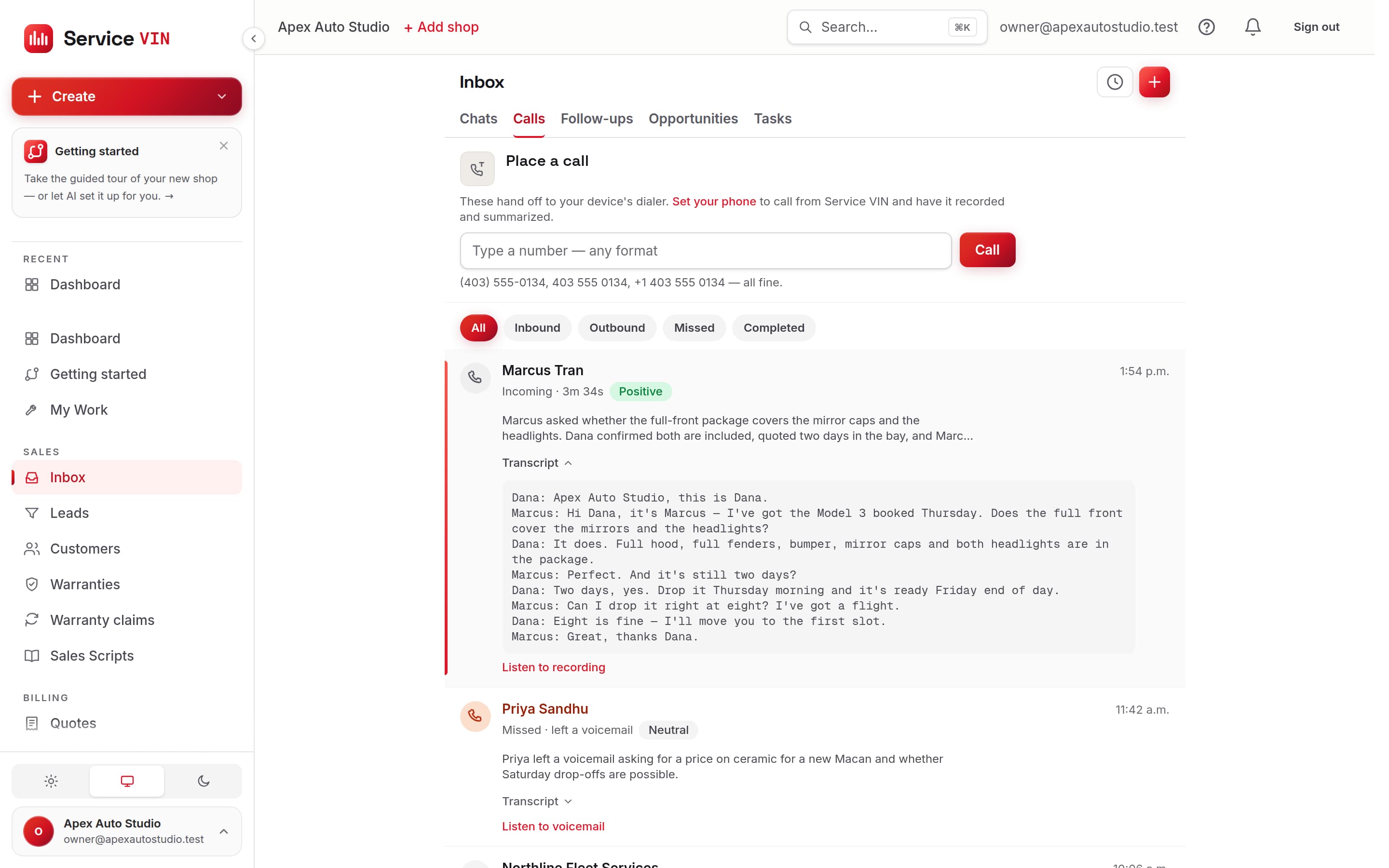
- A request arrives with the vehicle and the work on it, threaded onto the customer's record, ready for whoever is at the counter to put into your own schedule.
- Every call on the record
- Calls are recorded, transcribed and summarised on the customer's thread, so the second call about the same set of winters is not a conversation starting from nothing.
And the half between seasons
Reviews asked, customers reminded, ads measured
The tire business is two rushes and a gap, and the gap is where the next rush is either booked or lost. The review ask, the seasonal reminder and the ads report all run whether the counter had a quiet minute or not.
- The review, asked without being remembered
- The ask goes out after the car leaves rather than when somebody thinks of it, and private feedback comes back to you instead of onto a public listing.
- A seasonal reminder to your own customers
- A text when the weather turns, from the shop's line, to people who have not opted out, with quiet hours and a per-customer limit on unprompted messages enforced in code.
- Ads measured against booked work
- Your Google Ads spend is reported beside what it actually brought in, so the question becomes what a booked car cost rather than what a click cost.
What you get, and what you keep
The phone, the missed call, texting, reviews, your Google Ads and their return, booking requests, quotes for work that needs no parts catalogue, and a secure page for every quote, invoice and receipt.
It does not do labour guides, parts ordering or digital inspections yet. Keep your shop system for the repair order. Give us the phone.
What the front desk costs a tire shop
Four flat plans for the whole shop, Essentials $79, Growth $199, Operations $299, Command $399 in US dollars, with no per-seat charge, so a seasonal hire never moves the bill. The phone line and the call intelligence are on the Operations plan at $299 a month, and every plan starts with a 14-day free trial with every feature unlocked.
Your arithmetic
About 4 jobs a month — $6,500 of work.
If one of those becomes a job this month, the front desk paid for itself 5.0× over.
Your numbers, not ours. We don't publish other shops' recovery rates. The Operations plan is $299 a month, so the multiple above is one job of the size you typed against one month of the offer.
Start with the call you missed. It is included on the Operations plan, with your own business number, and it runs beside the point of sale and the fitment tools you already have, so there is no migration and nothing to retrain anybody on.
Where to start
It starts with the call you missed.
Every missed call answered in seconds. The quote you promised, drafted before you hang up. Booked straight into your calendar.
It answers from your real services, your real prices and your real calendar — and writes the booking into them. No migration, no data to move — it runs beside whatever you use today.
A customer reading a text in her parked car, a shop owner at her laptop and at the shop's glass door, and the call, text-thread, quote, calendar and review panels drawn over the pictures.

The front desk for a tire shop, answered
Can it quote a set of tires by size and fitment?
No. A tire quote needs fitment by year, make, model and trim, a size with its load and speed rating, a TPMS part number and live stock from your distributors. That is a catalogue and two data feeds we do not have, and pretending otherwise would waste your first week. Your existing tools keep that job.
So what does it actually do for a tire shop?
It takes the front desk and the marketing. Every missed call is texted back from your own number in seconds, calls are recorded and summarised onto the customer's thread, booking requests arrive with the vehicle and the work on them, the review ask goes out on its own, and your Google Ads spend is reported against the work it brought in.
The busiest week of the season is when we answer fewest calls. Does that help?
That is the week it is worth most. When both techs are on a lift and the counter has a queue, the phone is what gets sacrificed, and a changeover customer who reaches voicemail simply rings the next shop. A text back from your own number within seconds holds that customer long enough for somebody to get to them.
Can I text customers when the seasons turn?
Yes, from the shop's own carrier-registered line, to customers who have not opted out, with quiet hours enforced in code and a per-customer limit on unprompted commercial messages that you cannot accidentally switch off. It is a reminder to people you already serve, not a list anybody bought.
Does it track road hazard warranties or seasonal tire storage?
Not as a tire product. Warranty registration and expiring customer links exist and are built around film and coatings rather than a tire and a rack location, so treat storage and road hazard as something your own system keeps. This page is deliberately narrow about that.
Do I have to leave the system I run the shop on?
No. This is the layer beside it. Nothing is exported, nothing is retyped and your repair orders, stock and fitment stay where they are. That is also why a tire shop is usually live the same week: a number, your hours, your services and your voice.
How much is it?
Essentials $79, Growth $199, Operations $299 and Command $399 in US dollars, flat per shop, with no per-seat charge, and the phone line and call intelligence on the Operations plan at $299 a month. Every plan starts with a 14-day free trial with every feature unlocked, and there is nothing to migrate before you can judge it.
Does it handle GST/HST and CASL?
Tax: your shop sets one rate and every line on an invoice is taxable or exempt against it, so GST at 5 percent or HST at 13 or 15 is a setting rather than a workaround, and the sales-tax report gives your bookkeeper the taxable base, the exempt base and the tax actually charged on an accrual or a cash basis. What it does not do is split one invoice across two provincial rates, because there is a single shop-wide rate and no per-line rate in the data; if you bill at two rates, check that first. CASL is not a switch somebody flips but a set of rails: service and appointment messages are treated separately from marketing, marketing is counted against a per-customer limit, quiet hours and opt-outs are enforced in code, and an opt-out applies across the whole shop. The SMS policy page sets out the rules the product follows, and nothing here is legal advice.
Keep your counter system. Give us the phone.
Every missed call texted back from your own number, booking requests in writing, reviews asked and ads measured, with nothing to migrate. Start a 14-day free trial with every feature unlocked, no credit card required.
More for repair-side shops
- AlternativesTekmetric alternatives
- AlternativesShopmonkey alternatives
- CompareService VIN vs Tekmetric
- CompareService VIN vs Shopmonkey
- GlossaryWhat speed to lead means
- Front deskAI front desk for auto shops
- Solutionsauto repair shop software
- Solutionsmobile mechanic software
- Solutionscar audio shop software
- AlternativesTorque360 alternatives
- AlternativesShop Boss alternatives
For Canadian shops
Plans are billed in US dollars, and the rest of the block is the part a Canadian tire shop actually asks about. Tax is one rate for the whole shop, set once, so a 5 percent GST shop and a 13 percent HST shop each bill their own number and each line is taxable or exempt on its own. The sales-tax report then gives a bookkeeper the taxable base, the exempt base and the tax actually charged, on an accrual or a cash basis, and the same figures reach QuickBooks Online and Xero.
One rate is one rate. If you bill at two different provincial rates from the same shop, there is no per-province or per-line split here and that is a real reason to check before you move.
On the texting side, Canadian carriers require no 10DLC registration, so a Canadian shop sends from its own number as soon as the line is live rather than waiting on a US carrier review. Service and appointment messages are counted separately from marketing, marketing is held to a per-customer limit, quiet hours are enforced in code rather than in a setting somebody can forget, and an opt-out applies across the whole shop rather than to one thread.
The longer version, including what the invoice looks like and what the rails do about consent, is on shop software for Canadian shops, and the rules themselves are on the SMS opt-in policy page.
Related reading
- Articlestop double booking bays
- Articleno show policy
- Articleget paid faster shop