True margin quoting for shops. Your quote already knows what the film cost you.
Service VIN prices every line from the roll on your rack instead of a list price typed in once. Margin moves as you build, and once your installers' rates are in, it is margin after labor too.
Free for 14 days · no credit card required
Costed from your own rolls, margin after materials and after labor, from $79/mo
An empty film bay with a glossy black bonnet on panel stands, clear film half laid across it.

One full front, costed from the roll it comes off.
Watch the number rather than read about it. The margin moves four times, and only the last figure is the one that matters.
An example: a Gloss PPF · 60in × 100ft roll received into inventory at $2,150, which is $21.50 a foot. A full front at $1,850 draws 17.4 feet; rocker panels at $380 draw 4.2 more. A 2.8-foot offcut goes back on the shelf, so the job carries $404.20 of film rather than $464.40, and margin after materials is 82%. 6.5 hours of installer time at $34 an hour takes it to 72%, $1,604.80 on a $2,230 job. Illustrative prices and pay rate, not a rate card.
Inventory · the shelf
Roll R-1041
100 ft received
Gloss PPF · 60in × 100ft
- What you paid
- $2,150
- Cost per foot
- $21.50
The remnant is usable stock again, so it stops being this job's cost.
Quote builder
- Materials, from the roll
- −$404.20
- Installer time
- −$221
72%
Margin after materials and labor · $1,604.80
- Roll received
- Full front
- Rockers
- Offcut shelved
- After labor
14-day free trial — no credit card required, cancel anytime
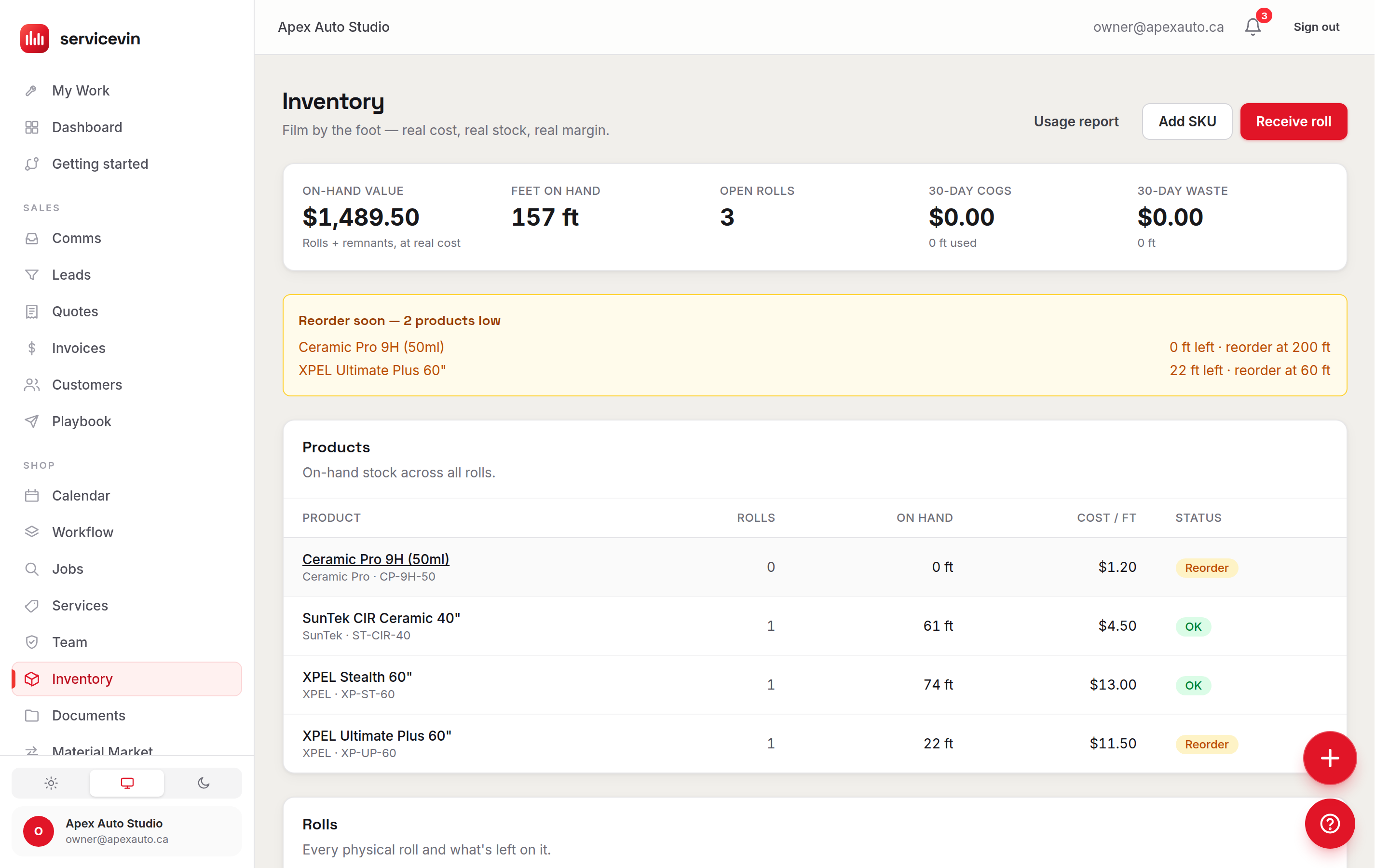
Receive the roll once; the quote reads it forever.
A roll of film is a four-figure asset that leaves the shop eighteen inches at a time. The shelf is the record.
- A roll costs what you paid for it, from the invoice in your hand
- It draws down by the foot, onto the job it went on
- A usable offcut goes back on the shelf at what it cost
- A reorder point warns you mid-quote, while there is time to ship film
Margin after materials is half the answer.
Film is the cost that is easy to see. People are the cost that decides the job.
The person you assign is the cost you carry
Pick the installer and their rate becomes the job's labor cost. Hours come off the clock and the per-item stopwatch, so the labor is what the job took.
- A per-job payout for a rostered contractor with no login at all
- Pay rates are managers only, enforced at the route and at the row
- Film plus labor, live, for each job and each mix of people
A sample job cost card: the quoted price, less the film from the roll, less one installer's hours at an example rate, leaving a margin after labor of 72 percent.
14-day free trial — no credit card required, cancel anytime
Would rather be walked through it on your own numbers? Request a demo.
A thin job is obvious while you can still fix it.
Margin moves as you type and colors itself, and it stays on the quotes list beside the status, so you can read which quotes are worth winning down a column.
HealthyThinLosing money
The finished job, costed the way it ran.
Reports, Job profitability sets each job's revenue against what it used: film off the roll and the waste cut on it, installer pay from the pay ledger, a labor burden, and other costs. It is on every plan.
What it leaves out: a job with no bill and no accepted quote is flagged instead of counted as zero, hourly shift pay sits on its own line because it belongs to no single job, and money taken in the Stripe Dashboard, outside Service VIN, is not in the processing figures. See the reports library
“So I’d have to enter all my costs first.”
Some of them, yes. Here is where the work is.
Moving from another system? Our team maps and loads your CSV, with a go-live target of 48 hours from your file. How the migration works.
No credit card required
The questions an owner asks first.
How does Service VIN know what my film costs?
Every roll you receive carries its own cost, length, lot and rack location, and draws down foot by foot as you log work against it. The quote builder reads that shelf, so a film line is costed from the roll on your rack, whether you quote by the foot or as a package.
Do I have to enter all my costs before I can quote anything?
No. You can quote on day one with no costs entered; the margin figure is only as good as what you have entered. Film cost arrives when you receive a roll, once per roll. Services and pay rates are set once in your price list and team roster.
Is the margin after labor, or only after materials?
Both, and Service VIN shows the difference. Materials come off the roll; labor arrives when you assign an installer, whose pay rate and hours flow into the job's cost. The server re-computes the same math on save, so the number you watched is the number that gets stored.
Who on my team can see margin and pay rates?
Only managers. Pay rates, HR fields and the full roster sit behind the owner and admin boundary, enforced at the route and at the row. The installer app does not load a quote, an invoice, a price or a job's margin at all.
Which plan do I need for this?
Live-margin quoting and film-roll inventory are on Essentials, the entry plan at $79/mo. The team roster that costs installer pay into a job is on every plan; Essentials includes 3 team logins and Growth makes them unlimited. Every plan starts on the same 14-day free trial — no credit card required, cancel anytime.
Know what the job makes before you send it.
Build one quote and see whether the number changes how you price.
Receive one roll at what you paid, build a full front against it, and look at the margin before you send.
14-day free trial — no credit card required, cancel anytime