Shop operations
Service Descriptions a Customer Can Book From
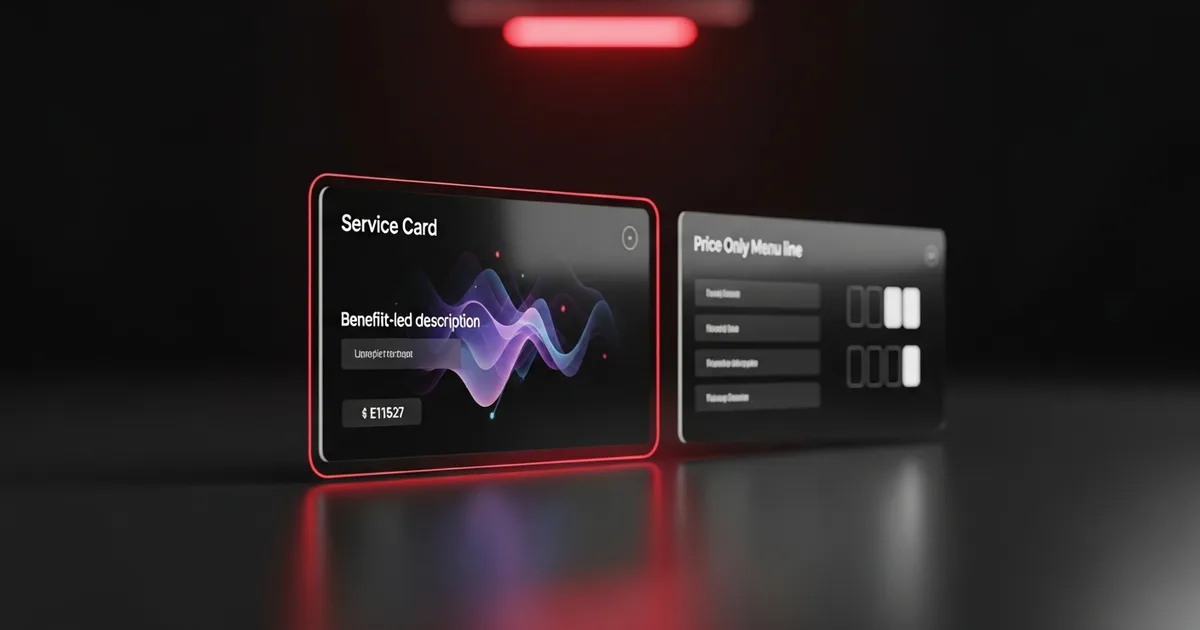
The short version
Good service descriptions do three jobs in under 500 characters: the first line says what the customer gets, the next lines list what is covered, and the copy answers how long the car stays. Keep prices and durations in their own fields, because a figure typed into the words goes stale the day the price moves.
- Write for where it is read: the booking card shows only the first line, the detail view shows every line as a checklist.
- First line: the outcome in the customer’s words. Then one covered part per line.
- Answer the counter questions in the copy: how long, what is included, what care follows.
- Leave the price and the duration to their own fields so the words cannot disagree with them.
Shop operations7 min readUpdated
Four places one description is read
A service description in Service VIN is one field, up to 500 characters, and it is read in more places than the booking page. Each place shows a different amount of it, which decides how it should be written.
| Where | What of the description shows | What that asks of the writing |
|---|---|---|
| Booking card | The first line, cut at two lines, on a wide enough screen | The first line stands alone and says the outcome |
| Service detail | Each line as a checked item, five before “show more” | One covered part per line, most important first |
| Quote line | The whole description, copied into the line’s details | Only what is true for every car it is sold on |
| Drafted replies | About the first 120 characters, beside price and duration | The opening sentence is what a drafted text can quote |
Read down the right-hand column and the shape writes itself: one line that sells, then a short list, with no line that has to be corrected per job. On a phone-width panel the card leaves the description off altogether, so the service name has to be clear without it.
The first line carries the outcome
The customer is buying a front end that survives the highway, a cabin that stays cool, an interior that smells new again. The film, the coating and the extractor are how the shop delivers that. So the first line names the result and the next lines prove it.
A quick test for the first line: read it and ask “so what?”. “Ceramic coating adds a hydrophobic layer.” So what? “Mud and bugs rinse off with a hose.” That answer is the first line. Keep asking until the sentence is one a customer at the counter would nod at, then stop, because the card cuts it at two lines.
Write it the way the shop talks. Short sentences, the trade’s own nouns (hood, mirror caps, cure time), and no brochure words like “premium solution” or “superior protection”, which give the reader no picture.
Covered parts, one per line
The most common question about a film package is what it covers. “Full front” means different panels at different shops, and the customer has usually read a price somewhere for a coverage they have not seen spelled out. A car owner reading about what goes into a full front PPF cost is told to ask exactly this, so answer it before they ask.
Because the detail view turns each line into a checked item, list one part per line: hood, front bumper, fenders, mirror caps, headlights. Put what is excluded on its own line too (“Door edges and lower rocker panels are separate add-ons”), since an exclusion nobody wrote down becomes an argument at pickup. Five lines show before the customer has to tap for more, so the five that decide the sale go first.
Time, care and the questions the counter hears
Three questions come up under almost every service: how long the car stays, how long the result lasts, and what the owner has to do afterwards. The first is answered by the service’s duration, which Service VIN stores in its own field and the drafter reads beside the price, so the description can say it plainly (“a full day in the bay”) without a number that has to change when the job does.
How long the result lasts is a warranty question, and the answer belongs to the film or coating maker. Name the warranty as the manufacturer writes it and leave the length to their documents; a typed “10 years” on a menu line is a promise the shop now owns. Aftercare is one line: “No washing for a week while the film cures” saves a phone call and a lifted edge.
Keep the price out of the words. The card shows the price from the catalog, and a quote is priced from the vehicle. A dollar figure typed into the description is the one that goes wrong when prices move. The arithmetic behind the price itself is in our guide to pricing a PPF job.
Example: a full front package, before and after
Example only. The wording below is ours, written for this post; it is not taken from any shop’s menu, and the coverage is one common version of a full front.
Before: “Full front PPF. Self-healing urethane film.”
After, one line per row as the shop would type it:
- Rock chips land on the film, and the paint underneath stays factory.
- Covers the hood, front bumper, both fenders and mirror caps
- Headlights included
- Edges wrapped where the panel allows, so no film line shows
- One full day in the bay; book a ride or a drop-off
- No washing for seven days while the film cures
The first line reads alone on the card. The next five fill the checklist before “show more”. It holds no price, and no line changes from one car to the next, so it can copy onto every quote unedited.
- 1
Line 1: the outcome
What the customer gets, in their words. It stands alone on the booking card.
- 2
Lines 2 to 4: what is covered
One panel, part or step per line, most important first.
- 3
Line 5: what is not
The exclusion that would otherwise be an argument at pickup.
- 4
Line 6: time and care
A day in the bay, a week before washing. No price; that field is separate.
Follows where Service VIN shows the field: the card reads line one, the detail view lists the rest as a checklist.
One catalog entry, every page that sells it
A description written well once should not be rewritten for the booking page, the quote and the drafted reply. In Service VIN the service is defined once in the catalog, and the shop service management software hands the same words to the online booking storefront, to every quote line the service is added to, and to the drafter. Improve it in one place and the next quote carries the new version. How the catalog fits a film shop’s whole week is on the PPF shop software page.
A sensible first hour: open the three services that earn the most, rewrite each in this shape, and check the card and the detail view on the booking page before moving on to the rest.
What the catalog will not write for you
Service VIN stores the description, trims it to 500 characters and shows it where it is read. It does not write it, check it against a manufacturer’s warranty or update a price typed into it. On a narrow phone panel the booking card shows the service name without the description, and a quote line keeps the words it was given until someone edits that line.
Frequently asked questions
How long should a service description be?
Long enough for one outcome line and a short list of what is covered, which usually lands well under the 500-character field. The booking card shows only the first line, so that line has to make sense alone.
Should the price go in the description?
No. The price lives in its own field and shows on the card and the quote. A figure typed into the words is the one that goes stale when prices change.
Features or benefits first?
The benefit first, in the customer’s words, then the parts and materials that prove it. “Rock chips land on the film” before “self-healing urethane”.
Does editing a description change old quotes?
No. A quote line gets the description copied in when the service is added, and keeps those words. New quotes, the booking page and drafted replies read the new version.

The Service VIN team
Built inside a working PPF and detailing shop in Canada
The team that builds Service VIN runs it every day inside a working PPF and detailing shop in Canada, the shop it was built for. These posts are written from that shop floor, for owners who want less time at the desk and more time running the business.