Ceramic & detailing
How to Build a Detailing Service Menu
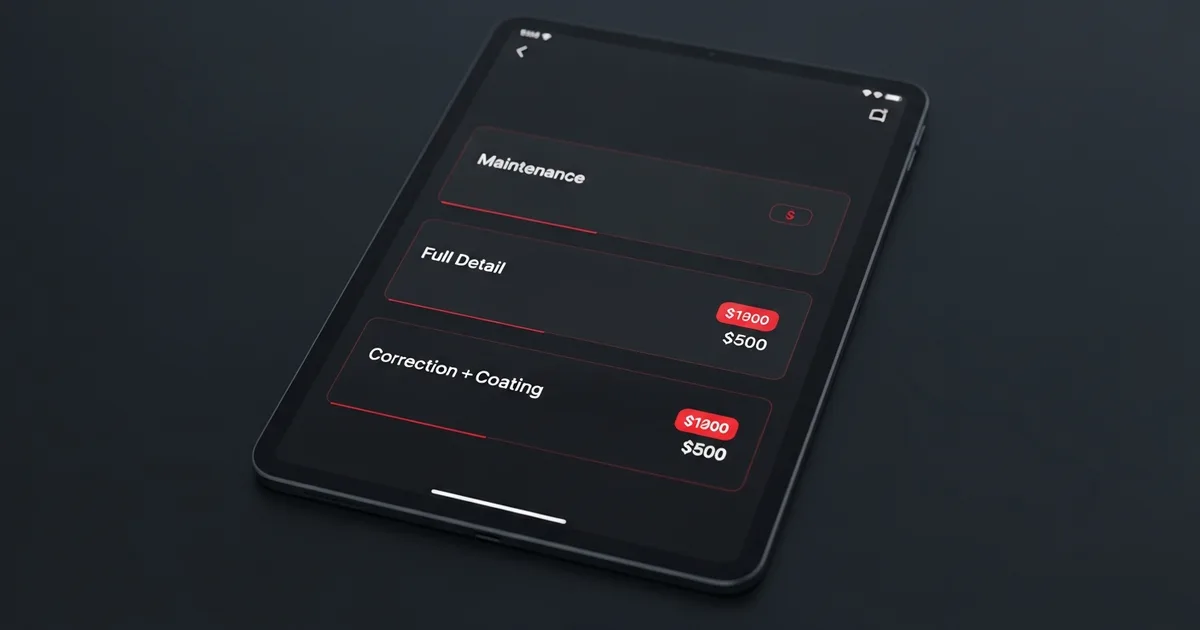
The short version
A detailing service menu that sells is short: three packages a customer can tell apart, add-ons on a shelf beside them, each service priced on the model that fits the work (flat, by vehicle, by area or by the hour), costed before it is priced, and named for what the customer gets.
- Lead with three packages; pet hair, engine bays and headlights sit beside them as add-ons.
- Price each kind of work on its own model: flat for the same job every time, by vehicle for work that scales with the car, hourly for correction.
- Cost the time and product first; the price goes on top of a number you can defend.
- Name each package for the result and print what it covers.
- Keep one entry per service, so the quote, the booking page and the job board show the same price.
Ceramic & detailing9 min readUpdated
What a customer does with a long menu
Faced with express, express plus, mini detail, mini plus, signature and signature deluxe, most people do not compare six options. They stall, ask what the difference is, and often book nothing. A detailing service menu has one job: let a stranger pick the right service in a few seconds and book it.
There is no published count of services that converts best, and this post does not invent one.
Six steps to a detailing service menu
Choose three core packages
A maintenance detail, a full detail and a correction with protection cover how most cars arrive.Move the extras to add-ons
Pet hair, odor, engine bay and headlights become priced extras offered with a package.Pick a price model per service
Flat, by vehicle type, per square foot, hourly or by quote, chosen by how the work scales.Cost it, then price it
Time and product first; the price goes on top, and the margin shows before anything is published.Name it for the result
A plain name and a short list of what it covers and what it does not.Publish it once
One entry per service, read by the quote, the booking page and the job board.
Three packages and a shelf of add-ons
The spine of the menu is three packages, each matched to a customer you already see: the regular who wants the car kept sharp (a maintenance detail), the neglected car that needs a reset inside and out (a full detail), and the owner who wants the paint fixed and protected (correction with a coating or sealant). Three gives a customer a ladder with a sensible middle step, which is where most of them land.
Everything else goes on a shelf beside the packages: engine bay, pet hair, odor treatment, headlight restoration. In Service VIN an add-on is either an extra on one service or a service of its own offered with every service in its category, with its own price per vehicle and its own time, so it is a yes added to a choice already made. A menu where every extra has equal billing with the packages is the wall that makes people freeze.
Where two or three services usually sell together, a package can hold them at one price. It sells as a card on the booking page and as one option on a quote, and the parts add up to the package price to the cent.
A price model for each kind of work
Detailing work does not scale one way, so one pricing method fits some of it and misprices the rest. A decontamination wash takes about the same on most cars. A coating grows with the size of the car. A correction grows with the paint: a swirled black car takes far longer than a clean silver one. The catalog offers five models, chosen per service.
| Price model | What it charges | Detailing work it suits |
|---|---|---|
| Flat price | One price whatever rolls in | Decon wash, headlight pair, odor treatment |
| Price by vehicle | A price per vehicle type; the booking page shows a "from" range | Full detail, interior tiers, coatings |
| Per square foot | A rate times the area | Coating or film on part of a car |
| Hourly | A rate times the hours the tech logs | Paint correction, heavy restoration |
| Custom, by quote | No fixed price; built on each quote | The oddball that fits no bucket |
The models live side by side, so a coating priced by vehicle and a correction priced by the hour sit on the same menu. The piece on paint correction pricing works the hourly case through.
Cost it, then price it
A price copied from a competitor's flyer carries none of your costs. Start from your own: the hours a service takes at what a bay hour costs you (wages and overhead together), the product it uses, and the pads and towels it wears out. That sum is the floor. The price goes on top, and the gap is the margin.
A service in Service VIN shows its margin once a cost is entered: good from 50 percent, OK from 30, thin below. A service with no cost entered shows no margin at all, which is the prompt to go and time it. The calculator below runs the same arithmetic on numbers you type. It is laid out for a film job; for a coating or a correction, use the product line for chemicals and the labor line for hours. The standalone PPF margin calculator does the same for any job with a cost and a price.
Reader-driven estimate from your own numbers — not a guarantee.
Every number is the one you type. Laid out for a film job; for a coating or correction, use the product line for chemicals and the labor line for hours.
Name it for the result
Customers buy a car that looks right and stays that way. "Stage 2 correction with a graphene topper" is a name for the bay; "Gloss restore and protect" is a name for the person paying. Keep the technical scope (pads, passes, products) on the work order and in training, and put the outcome on the face of the service.
Under the name, two short lists do more than a paragraph: what the service covers and what it does not. Service VIN keeps both on the service, and the AI tools that answer customers promise only what the covers list names. The post on service descriptions goes further into the wording.
One entry, read by the quote, the booking page and the board
Price drift starts when a service lives in three places. The full detail goes up in the quote tool, the website keeps the old figure, and a customer books the old figure two weeks later. In Service VIN a service is one entry, with its price, time and the bays it can run in, and the quote builder, the booking page and the job board all read it. A price changed once is changed everywhere.
A menu that already exists does not need retyping. From Services, Import, the catalog can read a page of your website, a photo of a printed menu, or, once an old system's invoices are imported, build the menu from what customers paid, with the middle price and range for each service. Every row is reviewed before it is saved. How the catalog fits the rest of a detail shop is on the page for auto detailing business software.
What the catalog will not decide
It does not set your prices, suggest a market rate or tell you which services to cut. The margin it shows is only as good as the hours and product cost you enter, and a published price range for your area is something you read elsewhere: the ranges customers see are collected on our page about car detailing prices.
A look at the menu every quarter
Product costs creep and demand moves. Once a quarter, pull the invoices for the period and look at three things: services nobody booked, services whose cost has risen past their margin, and packages that both sell and hold their margin. Cut the first, reprice the second, put the third first on the booking page. With one entry per service, each change is one edit.
For the interior tier of the menu, the interior detailing checklist shows how one task list splits into packages, and ceramic coating packages does the same for the protection end.
Frequently asked questions
How many services should a detailing menu have?
There is no published number that converts best. A useful shape is three packages a customer can tell apart, with extras such as pet hair, odor, engine bay and headlights offered as add-ons beside them rather than as headline items.
Is detailing priced by vehicle size or by the hour?
Both, for different services. Work that grows with the car, such as a full detail or a coating, prices well by vehicle type. Work that grows with the paint's condition, such as correction, prices by the hour. Flat suits the job that takes the same time on most cars.
How is a price set for a menu item?
Time it, multiply the hours by what a bay hour costs you, add product and consumables, and put your margin on top. Copying a competitor's price copies none of your costs.
Can an existing price list be imported instead of typed?
Yes. From Services, Import, Service VIN can read a page of your website or a photo of your menu, or build the menu from what customers paid once old invoices are imported. Every row is reviewed before it is saved.

The Service VIN team
Built inside a working PPF and detailing shop in Canada
The team that builds Service VIN runs it every day inside a working PPF and detailing shop in Canada, the shop it was built for. These posts are written from that shop floor, for owners who want less time at the desk and more time running the business.