Ceramic & detailing
How to Start a Mobile Detailing Business
The short version
Start a mobile detailing business by registering and insuring it, kitting a van with a pressure washer, vacuum, polisher and water and power you control, pricing packages from your real time and product cost, and putting online booking with deposits in front of customers from the first week.
- Mobile detailing skips rent and buildout, which is why startup costs run lower than a fixed shop — but you still fund a van kit, water, and power.
- Register the business (an LLC is a common choice for liability protection) and carry insurance before you touch a customer's car.
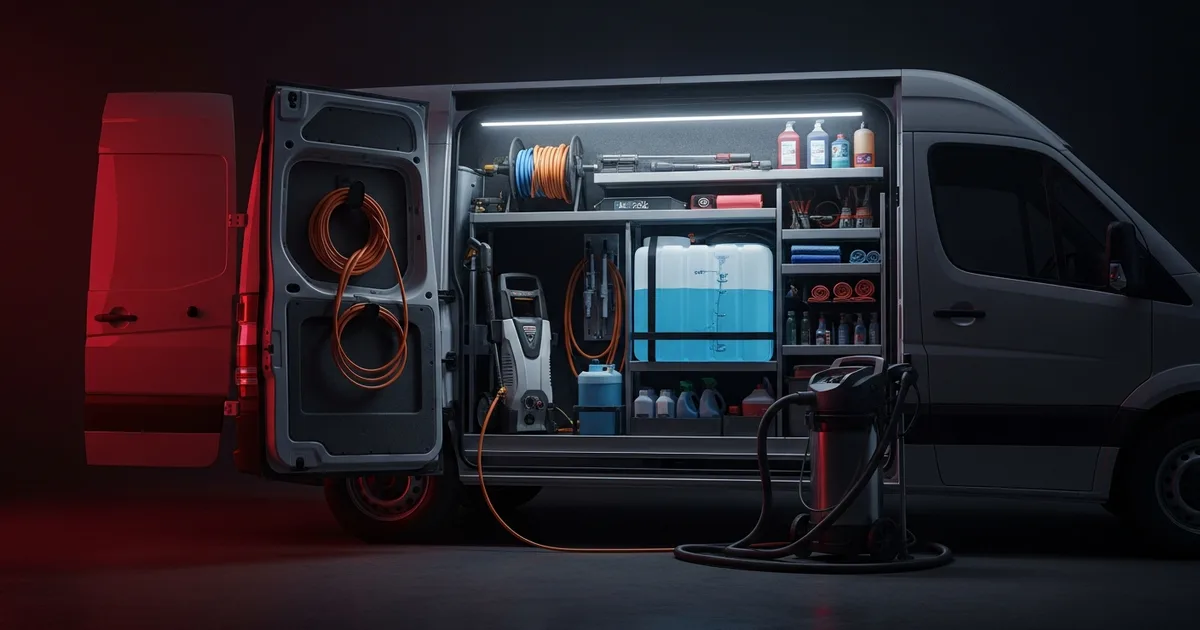
- Core kit: pressure washer, dual-action polisher, wet/dry vac, foam cannon, chemicals, brushes and towels, plus a water tank and a generator to work off-grid.
- Runoff matters — many areas don't let you dump wash water into a storm drain, so plan reclamation or a waterless method before your first driveway job.
- Price each package off real time and product, and set up online booking early so you're filling a calendar instead of chasing texts.
By Gabriel, who runs a working PPF and detailing shop in Canada.
Ceramic & detailing10 min readUpdated
Why mobile is a different animal than a fixed shop
The best reason to start a mobile detailing business is the bill you get to skip: the rent. No lease, no bay buildout, no landlord deciding your hours. For a lot of people that's the whole reason to start here instead of signing a five-year commercial lease before you've done a single paid job.
The trap is thinking that makes it cheap. It doesn't. Your bay is now a van, and that van has to bring everything the building used to give you for free — water, power, a real kit, and somewhere for the dirty water to go. You didn't delete the shop's overhead. You put it on wheels and made it your problem to haul around.
So the barrier to entry is genuinely lower, and the logistics are genuinely harder. That's the trade. I run a paint and detail shop in up north, where a driveway can be frozen solid five months a year, and the operators I see succeed at mobile are the ones who treat that trade seriously from day one — they build a real rig and a real way to get booked, not just a nice buffing pad and a hope. Here's the order I'd do it in. Software like a mobile detailing platform handles the booking and routing later, but the build comes first.
- Equipment35%
- Van & setup30%
- Products20%
- Marketing15%
| Segment | Value | Share |
|---|---|---|
| Equipment | 35 | 35% |
| Van & setup | 30 | 30% |
| Products | 20 | 20% |
| Marketing | 15 | 15% |
The six-move build for a rig that actually earns
Register the business and get insured
Before you wash one car for money, make the business real. Form an entity — an LLC is a common choice because it puts a wall between a bad day at work and your personal savings — and get whatever business license your city or county asks for. Rules vary by where you operate, so verify your local requirements rather than trusting a checklist you found for another state.
While you're at it, open a separate bank account for the business and run every dollar through it. It costs you nothing today and it saves you a miserable weekend next spring untangling which gas fill was yours and which was the van's. Clean books start with not mixing the money in the first place.
Then insurance, and this is the one people skip because it feels like paying for nothing. You are putting pressurized water, chemicals, and a polisher against a stranger's paint, in their driveway, next to their garage door and their kid's bike. General liability is the cost of being allowed to touch expensive cars. Carry it before the first job, not after the first claim.
Kit the van with the tools that pay for themselves
The earners are boring and specific: a pressure washer, a dual-action polisher, a wet/dry vacuum, a foam cannon, a set of brushes and microfiber towels, and a core chemical lineup — soap, an all-purpose cleaner, an interior cleaner, glass cleaner, and a sealant. That short list does the vast majority of what a customer is actually paying for.
Open lean. You do not need eight polishers and a shelf of boutique waxes to detail a car well — you need the tools that turn hours into finished work, and the discipline to reinvest the first jobs' profit into the extras once the demand is real. Buy for the jobs you have, not the jobs you're daydreaming about.
And budget for the boring spend nobody photographs for the feed. Towels wear out, pads tear, pad backing gives up, and chemicals get burned by the bottle. The tools are a one-time hit; the consumables are a recurring line item, and they're exactly what a slapdash quote forgets to cover — which is how a detailer stays busy all summer and still ends the season wondering where the money went.
Solve water and power
A fixed shop hands you a tap and an outlet. A driveway hands you nothing you can count on. So the rig carries its own: a portable water tank with a pump, and a generator to run the equipment. A typical setup runs a fifty- to hundred-gallon tank, sized to how many cars you want to knock out between refills.
Two things people learn the hard way. Water is heavy — it's about eight and a third pounds a gallon, so a full hundred-gallon tank is pushing a thousand pounds sitting in your van before you've loaded a single towel. Mind your vehicle's payload. And size the tank to your real day: too small and you're hunting for a hose between jobs, too big and you're hauling a boat anchor around town for water you never use.
Power is the half people underestimate. Your pressure washer and vac don't pull much on their own, but a cheap generator that can't hold its voltage will cook a motor over a season, so size it to your gear with headroom to spare and don't run it down to fumes. And remember you're firing up an engine in someone's quiet residential driveway at nine on a Saturday — plenty of neighborhoods have noise rules, and a screaming open-frame generator is the fastest way to turn a happy customer's whole street against you. An inverter model costs more, and it's worth every dollar in the complaints you never end up hearing.
Handle runoff and stay compliant
Here's the one that quietly fines people. In a lot of jurisdictions you are not allowed to let wash water run off into a storm drain — that water goes straight to a creek or a river, untreated, and the soap and grime with it. The sticking point usually isn't the washing. It's where the dirty water ends up.
So plan for it before you advertise a driveway wash. That might mean a reclamation setup that captures and contains the runoff, or leaning on rinseless and waterless methods that barely produce any. Whatever you choose, check your local rules first. A citation is a rough and expensive way to learn what your city thinks about the water on your customer's driveway.
Build a service menu and price off real time
Don't offer everything. Offer a few clear packages — say a maintenance wash, a full interior-and-exterior detail, and a premium correction-and-protection tier — so a customer can choose without a twenty-minute phone consult. Three good options beat thirty confusing ones.
Then price each one off the work, not a round number that feels nice. Add up the real hours it takes, the product it burns, and a slice of your overhead — fuel, water, insurance, the gear wearing out — and set your margin on top of that. When you price the actual work, a discount is a decision you make with your eyes open instead of a surprise you discover at tax time.
Build a couple of add-ons into the menu too — pet hair, engine bay, a headlight restoration, a ceramic top-up. They're the easiest money in the trade because the van's already there and the customer's already sold; you're just saying yes to a little more. And resist the urge to be the cheapest van in town. The race to the bottom has no winner, only a tired detailer wondering why the calendar's full and the bank account isn't.
Get booked online instead of playing phone tag
The fastest way to stall a new mobile business is to make every booking a text-message negotiation. You're elbow-deep in a door jamb, your phone's buzzing, and by the time you wipe down and reply the customer has booked whoever answered first. Stand up an online booking storefront early — one that shows your real open slots, takes the appointment, and collects a deposit — so the calendar fills itself while your hands are busy.
The deposit does double duty. It cuts no-shows, because someone who put money down actually shows up, and it turns the 11 p.m. shopper — the one deciding on their couch, long after you've locked the van — into a booked job instead of a lost text. A storefront that works while you sleep is worth more to a solo operator than any single piece of equipment on this list.
The rule I'd give any new detailer
Buy the tool when the job pays for it, not before. Every dollar you sink into a shiny extra you don't have work for yet is a dollar that isn't buying gas, insurance, or a booking page that actually fills your week. Lean rig, full calendar — then upgrade. Not the other way around.
Reader-driven estimate from your own numbers — not a guarantee.
Punch in your own numbers: the requests that land after you've locked the van are only lost if there's no storefront to catch them.
What it costs to start a mobile detailing business
The published numbers here span a very wide band, and the reason is worth understanding before you read them: one source is costing a full rig with a van behind it, and another is costing somebody who already owns a car and buys a pressure washer. Both are real businesses on day one. The table below gives you the line items rather than a total, and every figure in it is linked and dated at the foot of the article.
| Line item | Published range | What it buys |
|---|---|---|
| Whole business, all in | $5,000–$25,0001 | The band one source gives for an initial investment. It is wide because it spans a van-and-kit start and a buy-as-you-earn one. |
| A lean first kit | About $400–$6002 | Bucket, a battery pressure washer around $170, an extractor around $120, a shop vac around $40, towels, brushes and chemicals — the other source's actual opening spend. |
| Dual-action polisher | $500 and up1 | The tool that turns a wash business into a correction business, and the first upgrade most detailers make. |
| Van or service vehicle | Not verified as of September 11, 2026 | Neither source priced the vehicle separately. If you already have one, this line is zero, which is most of why the band above is so wide. |
| Water tank, pump and generator | Not verified as of September 11, 2026 | The thing that makes the rig independent of a customer's outdoor tap. Price it from a local supplier — and size it to the cars you want to do between refills. |
| Insurance | Not verified as of September 11, 2026 | Named as essential — general liability, and garage keeper's liability for vehicles in your care1 — but no premium was published, and it varies too much by jurisdiction to guess. |
| Registration and licensing | Not verified as of September 11, 2026 | Varies by city, state and province. Any number printed here would be wrong somewhere. |
The pattern in both sources is the same and it is the useful advice: buy the tools that earn, take the jobs, and let the jobs buy the next tool. The detailers who get stuck are the ones who bought the $25,000 version of the rig before they had proved they could fill a week.
Where the startup figures came from
Facts checked
- 1.Mobile Tech RX, “How to Start a Mobile Car Detailing Business” — an average initial investment of around $5,000 to $25,000; a good random orbital polisher $500 and up; general liability and garage keeper's liability named as the insurance to carry. Read 2026-09-11, method: web-search snippet. mobiletechrx.com
- 2.Side Hustle Nation, “How to Start a Mobile Detailing Business” — an actual opening spend of roughly $400–$600 on equipment: a battery pressure washer around $170, an extractor around $120, a shop vac around $40, plus buckets, towels, brushes and chemicals, with more added out of revenue. Read 2026-09-11, method: web-search snippet. sidehustlenation.com
These were read through search-result snippets of each source's own page rather than a direct fetch, and equipment pricing moves. Check the page behind each link, and price your own list from local quotes before you commit.
The software you'll need
A mobile rig has a problem a fixed shop does not: you are physically unreachable for most of the working day. Your hands are wet, you are in somebody's driveway, and the inquiry that decides next Tuesday arrives while you are mid-polish. Five jobs, and one system that does all five beats five apps that each do one.
Quoting. Packages priced from the real hours and product each one takes, sent from your phone between cars rather than typed up at 10pm. The detailer who answers first usually books the job, and a quote that waits for the evening is a quote competing with one that did not.
Booking with deposits. A bookable page that takes a real slot and a deposit while you are under a car. This is the single biggest structural advantage a mobile business can buy, because it is the only thing that keeps selling while you work.
Product and film inventory. Coatings, compounds and consumables counted against jobs rather than guessed at, so a package carries its real material cost and you stop discovering an empty bottle in a driveway.
Texting. One thread per customer for calls, texts and web leads, tied to their vehicle and history — so a reminder, a rebook or a win-back is one tap instead of a scroll through a personal phone.
Invoicing. The invoice raised from the finished job and paid on the spot, with the review request going out while the shine is still fresh.
All five run on one record in Service VIN's software for mobile detailing, which carries the dispatch and installer-app half a rig needs on top of them. The customer side of the same problem — where the first fifty customers actually come from — is how to market a detailing business.
Get out of the bay and run the business
Here's the part nobody kits the van for. The goal isn't to be a person who details cars really well. The goal is to build a company that details cars — one that keeps running on a day you're sick, or on vacation, or just want an afternoon off. We're all installers before we're business owners, and the jump from one to the other is the whole game.
That jump is made of systems, and you should start building them on day one, not on day one thousand. Every finished job should trigger a review request while the shine is fresh. Every past customer should get a nudge before their car needs the next detail. Every quote that goes quiet should get a second touch instead of dying in your text thread. Do that by hand and it works right up until you get busy — which is exactly when you stop doing it. Put it on rails and it keeps working when you're buried.
The same goes for finding the customers in the first place. A rig and a booking page get you ready; a plan for filling it is its own job — worth reading up on how to market a detailing business before you spend a dollar on ads. And as the jobs stack up, run the quotes, the calendar, and the payments from one place instead of a spreadsheet, a booking app, and a payment terminal that never quite agree — which is the entire reason auto detailing software exists. Start the business like you intend to leave the driveway eventually. Because that's the point.
Frequently asked questions
How much does it cost to start a mobile detailing business?
Less than a fixed shop, because you skip rent and buildout, but the published figures span an enormous band and it is worth knowing why. Mobile Tech RX puts an average initial investment at roughly $5,000 to $25,000, with a good dual-action polisher at $500 and up. Side Hustle Nation describes an actual opening spend of about $400 to $600 — a battery pressure washer around $170, an extractor around $120, a shop vac around $40, plus buckets, towels and chemicals — with everything else bought out of revenue. Both are real starts; the difference is mostly whether you already own the vehicle. The van, the water tank and generator, insurance and licensing were not verified as of September 11, 2026, so build those lines from local quotes rather than a headline figure.
What software does a mobile detailing business need?
Five jobs, and the reason they matter more on a rig than in a shop is that you are unreachable for most of the working day. Quoting that sends packages priced from real hours and product, from your phone between cars. Online booking that takes a slot and a deposit while your hands are wet. Product and consumable tracking so a package carries its real material cost. One texting thread per customer, tied to their vehicle, so a rebook is one tap. And invoicing raised from the finished job, paid on the spot, with the review request going out while the shine is fresh.
What equipment do I actually need to start?
The earners are a pressure washer, a dual-action polisher, a wet/dry vacuum, a foam cannon, brushes and towels, and a core chemical set: soap, all-purpose cleaner, interior cleaner, glass cleaner, and a sealant. Add a water tank and a generator so you can work off-grid. You can open with a lean kit and reinvest into the extras as jobs come in.
Do I need a water tank and generator for mobile detailing?
Usually yes, because you can't count on a water tap or an outlet at every job. A portable tank and a pump give you your own water, and a generator runs your equipment. Size the tank to how many cars you want to do between refills, and remember a full tank adds serious weight to the van, so factor that into your setup.
Is it legal to wash cars in a customer's driveway?
It depends on where you work, and the sticking point is usually the runoff, not the washing. Many jurisdictions don't allow wash water to run into storm drains, so you may need a reclamation setup or waterless methods to stay compliant. Verify your local rules before you advertise driveway service, because a fine is a rough way to learn them.

Gabriel, who runs a working PPF and detailing shop in Canada
Runs a working PPF and detailing shop in Canada · builder of Service VIN
Gabriel runs a working PPF and detailing shop in Canada and built Service VIN. He got his start detailing and wrapping his own car, taught himself color PPF, and spent his day job in digital marketing and SEO before building the shop software he could never find. Six years in, he writes to help other owners get out of the bay and actually run their business.