Ceramic & detailing
Remove Swirl Marks by Leveling the Clear Coat
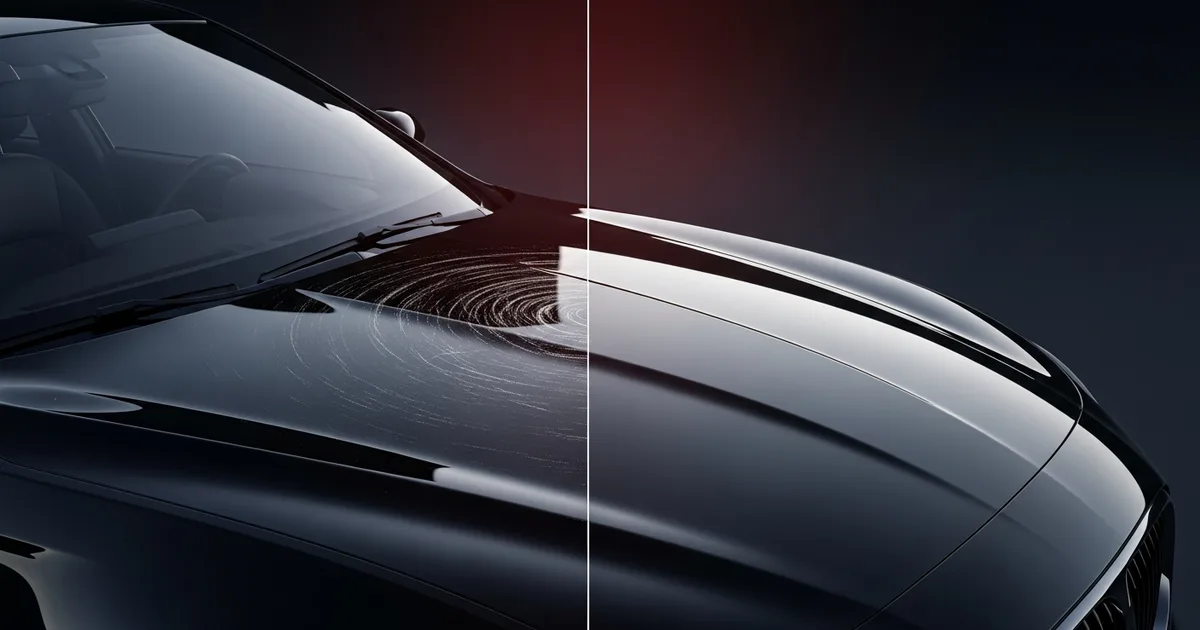
The short version
To remove swirl marks, a machine polisher and an abrasive take a thin layer of clear coat down to the bottom of the fine scratches, so the surface reflects light evenly again. A wax only fills them for a few washes. How hard to cut is set by a test spot, because clear coat does not grow back.
- Swirl marks are fine scratches in the clear coat, the top layer; the color under it is untouched.
- Most come from washing: grit in a mitt, a towel or a tunnel-wash brush drags across the paint.
- Dark paint shows them first because each scratch scatters light against a dark background.
- A coating and better wash habits after correction are what keep them from coming back.
Ceramic & detailing8 min readUpdated
Where a swirl sits in the paint
Factory paint is a stack: primer on the metal, the base coat that carries the color, and a hard transparent clear coat on top that does the protecting and the shining. Swirls are thousands of fine scratches in that top layer, laid in rough circles by the way the car was wiped. The color is not touched, which is why correction can work at all. The glossary entry on car swirl marks has the short definition for a customer.
That changes the conversation at the counter. A customer who thinks the color is damaged braces for a respray. "This is in the clear, and it can be leveled on the machine" turns the same marks into a routine service.
The wash puts them there
Swirls are rarely a sign of neglect. They are a sign of a car cleaned the wrong way: grit caught in whatever touches the paint, moved across it under pressure, cuts a fine groove with each pass.
- Dry-wiping dust. No lubrication, so the grit grinds across the panel instead of lifting off.
- A dirty mitt or towel. One dropped on the ground carries grit to every panel after it.
- Tunnel-wash brushes. Shared brushes bring the last car's grit to the next one.
- One bucket. The dirty mitt goes back into the same water and picks the grit up again.
The customer hears that the routine has a flaw, which is easier to accept than neglect, and it sets up the habit that keeps the fix.
Why black paint shows them first
A fine scratch scatters light instead of reflecting it cleanly, on every color. On black, each scratch glows against a dark background, so the whole web lights up in direct sun. On silver or white the same scatter blends into a light surface. The black car is no more swirled than the silver one; its swirls are just visible.
- 1
Grit meets clear coat
Dirt trapped in a mitt, towel or brush rides across the panel under pressure.
- 2
The scratch forms
The grit cuts a fine groove in the clear coat, one of thousands.
- 3
Light scatters
Each groove throws light in every direction, so the web shows in direct sun.
- 4
Polishing levels the surface
A machine and an abrasive take the clear coat down to the base of the scratches.
- 5
Light reflects evenly
With the surface flat again, the swirls are gone and the gloss returns.
A walkthrough of the mechanism, with no measured data in it.
Filling hides them, leveling removes them
A filler-heavy wax or glaze settles into the scratches and hides them for a few washes. Correction removes them: a machine polisher and an abrasive take the clear coat down to the base of the scratches, so there is no groove left to scatter light. The dashed line in the drawing is that depth.
Sanding a scuff out of a wooden table is the same idea. Nobody fills the scuff; the surface comes down until the scuff is no longer a low spot. Because the defect is gone, the gloss stays after washing.
Clear coat does not grow back
Each correction takes some clear coat away, and there is only so much to take over a car's life. So the cut matches the deepest defect worth removing, chasing every last micro-scratch on a daily driver is not always right, and the corrected paint gets protected so it does not need cutting again soon. A scratch that has gone through the clear into the color is a paint repair, and polishing will not remove it.
Choosing the cut from a test spot
Light swirls from a couple of years of drive-through washes come out in one pass with a mild compound-and-finish. Marks a fingernail catches need a cutting stage and then a refining pass. Years of neglect is a multi-stage job. A test spot under raking light, with the mildest combination that might work, settles which: if it clears, that is the level; if not, step up the cut.
Turning that level into a price is the subject of the post on paint correction pricing, with a worked example from bay hours. The customer's view of the same decision is on the paint correction cost page. In auto detailing business software like Service VIN, the levels can go on one quote as a choose-one group, each line showing its margin before the quote is sent.
Keeping them from coming back
Correction removes the swirls that are there today. If the car goes back through the same tunnel wash, new ones form within a season. Two things hold the work.
Protection. A ceramic coating or a sealant over freshly corrected paint adds a slick layer that is easier to wash and harder to mar. It does not make paint swirl-proof. The car-owner comparison of ceramic coating vs wax vs sealant helps a customer choose, and the ceramic coating pricing guide covers costing the coating half of the job.
Habits. Two buckets so the grit goes into the rinse water, clean plush towels, and no dry-wiping. A customer who has just paid for correction is unusually ready to hear it, framed as protecting the work they paid for.
What no software can judge on the paint
Service VIN does not inspect paint, judge swirl depth or choose the level. It prices the level the installer picked. Its aftercare texts ask what the job was for, so a correction with no coating gets no "fully cured" message unless the shop marks that category as one that cures.
Frequently asked questions
What causes swirl marks on car paint?
Friction while washing and drying. Grit caught in a mitt, a towel or a tunnel-wash brush drags across the clear coat and leaves fine scratches. Wiping a dusty car with a dry towel is one of the most common causes.
Can swirl marks be fully removed?
Yes, by machine polishing, as long as there is enough clear coat to work with and the scratches have not reached the color layer. The polish levels the clear coat to the base of the scratches, and a test spot sets how hard to cut.
Why do swirl marks come back after a polish?
Usually the wash routine did not change. Correction removes the existing swirls; tunnel washes and dry-wiping make new ones. A coating or sealant plus two-bucket washing keeps the result longer.
Will a wax hide swirl marks?
A filler-heavy wax or glaze hides them for a few washes, then they show again. Removing them means leveling the clear coat on a machine.

The Service VIN team
Built inside a working PPF and detailing shop in Canada
The team that builds Service VIN runs it every day inside a working PPF and detailing shop in Canada, the shop it was built for. These posts are written from that shop floor, for owners who want less time at the desk and more time running the business.